• About
  • Home
  • Contact
Obi Okoye
  • About
  • Home
  • Contact

Final Proposal - View from walway into central civil space

“So geographers in Afric maps
With Savage pictures fill the gaps
And over Uninhabited downs
Place elephants for want of towns”
— Swift 1733

/ Research - Igbo Architectural Heritage

For many centuries, sub saharan architecture has been seen as primitive, However Igbo architecture can also be seen as the product of physical and cultural factors, which create architectural problems and also provide some means of solving them. The physical environment, for instance, causes the problems of rain, heat and humidity, but provides mud, timber, bamboo and palms for house building. In the current climate where ideas of de-growth and challenging consumption are gaining traction, the traditional architecture adheres to the basic sustainability principles of energy efficiency and utilization of materials /resources in close proximity to the site. A taxonomy of traditional Igbo architecture was conducted to see what aspects could be relevant in the modern day

 
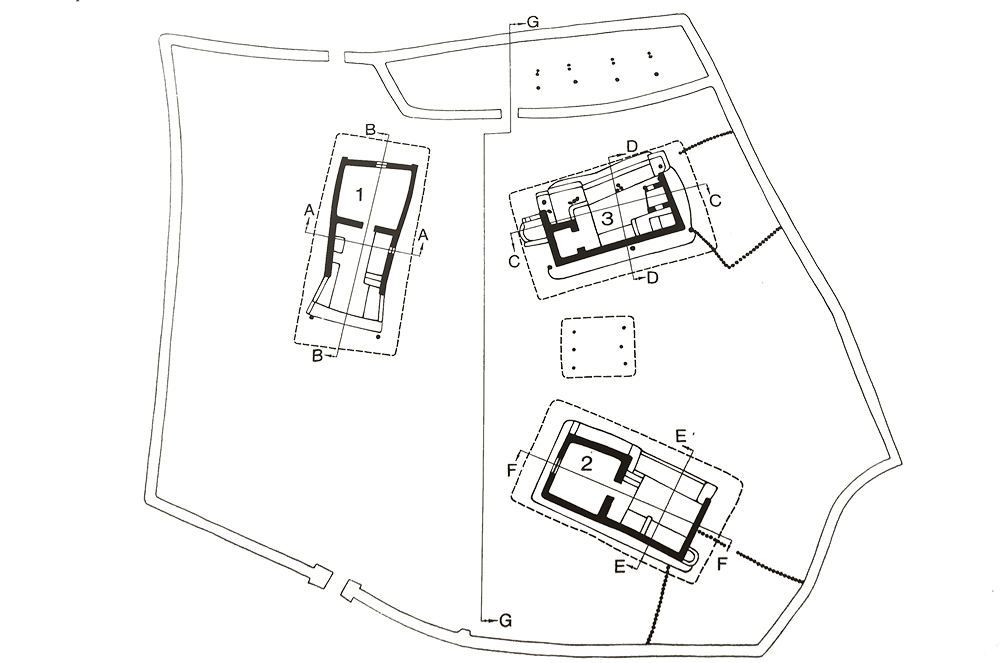
 Village settlement pattern - Example layout  showing compounds centred around a ward compound, which are in turn centred around a village square

Village settlement pattern - Example layout showing compounds centred around a ward compound, which are in turn centred around a village square

 Village group layout - Villages centred around a communal village group centre

Village group layout - Villages centred around a communal village group centre

 Impluvium type compound - Rooms are arranged around primary and secondary courtyards

Impluvium type compound - Rooms are arranged around primary and secondary courtyards


 Impluvium type compound - Isometric diagram

Impluvium type compound - Isometric diagram


 Impluvium type compound - Section through main courtyard

Impluvium type compound - Section through main courtyard

 Impluvium type compound - Section through altar

Impluvium type compound - Section through altar

 Impluvium type compound - Section through porch

Impluvium type compound - Section through porch

 Giant compound type - Houses form of perimeter wall enclosing a courtyard roughly oval in shape

Giant compound type - Houses form of perimeter wall enclosing a courtyard roughly oval in shape


 Giant Compound Type - Houses are formed from long narrow blocks and compartmentalised into rooms

Giant Compound Type - Houses are formed from long narrow blocks and compartmentalised into rooms

 Heartland compound type - A walled group of detached dwellings for the male head, his wives and children

Heartland compound type - A walled group of detached dwellings for the male head, his wives and children

 Construction -  Wattle and daub or skeletal structure with mud infilling

Construction - Wattle and daub or skeletal structure with mud infilling


 Decoration - geometric and Uli decorative motifs

Decoration - geometric and Uli decorative motifs

 
“When we gather together in the moonlit village ground it is not because of the moon. Every man can see it in his own compound. We come together because it is good for kinsmen to do so.
”
— Chinua Achebe's Things Fall Apart
 
 Decorative door - Compund entrances were often decorated to reflect the status of their owner

Decorative door - Compund entrances were often decorated to reflect the status of their owner

 Eroded wattle and daub structure

Eroded wattle and daub structure

 Village Square - tiered seats with tree cover in an square for public activities

Village Square - tiered seats with tree cover in an square for public activities

 Forked post - Naturally branched trunk used as post to support mid-purlin of steeply pitched roof

Forked post - Naturally branched trunk used as post to support mid-purlin of steeply pitched roof

 Communal building - Thatching the roof of a house in relays

Communal building - Thatching the roof of a house in relays

 Roof supports - short forked posts supported on brackets set into the wall

Roof supports - short forked posts supported on brackets set into the wall

 Impluvium compound type - View of impluvium with sacred Egbo tree

Impluvium compound type - View of impluvium with sacred Egbo tree


 Decoration - Clay wall decorated with inserted objects - cowies, enamel and glass

Decoration - Clay wall decorated with inserted objects - cowies, enamel and glass


 Carving - Carvings on a forked wooden post

Carving - Carvings on a forked wooden post

 Meeting Hall - View of meeting hall from village square

Meeting Hall - View of meeting hall from village square


 Meeting Hall - Moulded furniture and carved columns

Meeting Hall - Moulded furniture and carved columns


 Portico - Wall decorations inside portico

Portico - Wall decorations inside portico


/ Research - Umuahia

The site is located in Umuahia, capital of Abia state, which lies along the railway between the major urban centres of Port Harcourt and Enugu. It is an agricultural market centre. In precolonial times, it served as one of the central marketplaces in the region for commerce. Currently being the state capital it is also an administrative centre and many people are employed as civil servants.

Originally a village group, in line with colonial policy, it was developed into a town from its constituent villages. Since 1916 it became a collecting point on the railway for the crops of the surrounding region.

Colonial map of Umuahia - The settlement served as an administrative centre and a collecting point for crops and commerce due to the trainline running through it. It was segregated into European and native areas


Current Map - Rapid urbanisation has caused the city to expand into its constituent villages

 
 ”The Gate” - Location of the old market and considered to be the centre of the city

”The Gate” - Location of the old market and considered to be the centre of the city


 Expression - Some gates show signs of decoration bas relief on the concrete surrounds and decorative metal work

Expression - Some gates show signs of decoration bas relief on the concrete surrounds and decorative metal work

 City centre

City centre

 Encroachment - streets turned into impromptu trading posts with makeshift platforms over gutters

Encroachment - streets turned into impromptu trading posts with makeshift platforms over gutters

 Post colonial house - Typical house built by natives during early urbanisation period

Post colonial house - Typical house built by natives during early urbanisation period


 Railway - Once a source of the city’s growth it is used infrequently and the space is appropriated by street vendors amongst others

Railway - Once a source of the city’s growth it is used infrequently and the space is appropriated by street vendors amongst others

 Apartment blocks  - Typical of the city centre

Apartment blocks - Typical of the city centre

  Gated housing estate  - Developers focus on higher end  gated developments that few can afford

Gated housing estate - Developers focus on higher end gated developments that few can afford

 Gatehouse - Wealth can be expressed by the size abd style of compound entrances

Gatehouse - Wealth can be expressed by the size abd style of compound entrances

 Old vs. new - Earth building, which has been left to deteriorate, superseded by concrete structures

Old vs. new - Earth building, which has been left to deteriorate, superseded by concrete structures


Due to rapid urbanisation, The city of has expanded majorly into the surrounded villages and many have found themselves in the middle of the crossroads heading in and out of the city. The city faces many challenges but most relate to overcrowding due to urbanisation\ poor roads, lack of formal infrastructure, for example sanitation, drainage and piped water and a lack of access to communal space.

Ride through Umuahia


Two areas in particular were studied to try and identify a target group of residents for my scheme, and look at a cross section of living conditions. The World Bank Housing Estate a middle income area, and what was originally the ‘natives reservation’, a low income area showing a continuation of the original grid iron pattern, established by the British.

World Bank Housing Estate - Typical street section

World Bank Housing Estate - Plan of studio unit shared by husband wife and 2 children

 
Old natives reservation - grid iron pattern

Old natives reservation - grid iron pattern

 
Old natives reservation - View through verandah to courtyard, early town compound

Old natives reservation - View through verandah to courtyard, early town compound

 
Old natives reservation - Early post colonial building built by early town dwellers during first period of urbanisation

Old natives reservation - Early post colonial building built by early town dwellers during first period of urbanisation

 
Tenement building - Axonometric drawing of typical tenement building in old natives reservation. Originally built for people moving to newly formed towns for work

Tenement building - Axonometric drawing of typical tenement building in old natives reservation. Originally built for people moving to newly formed towns for work

 
Tenement building - Originally built for a single extended family, now several families can occupy one or more rooms. Rooms facing the street can also be rented out as shops
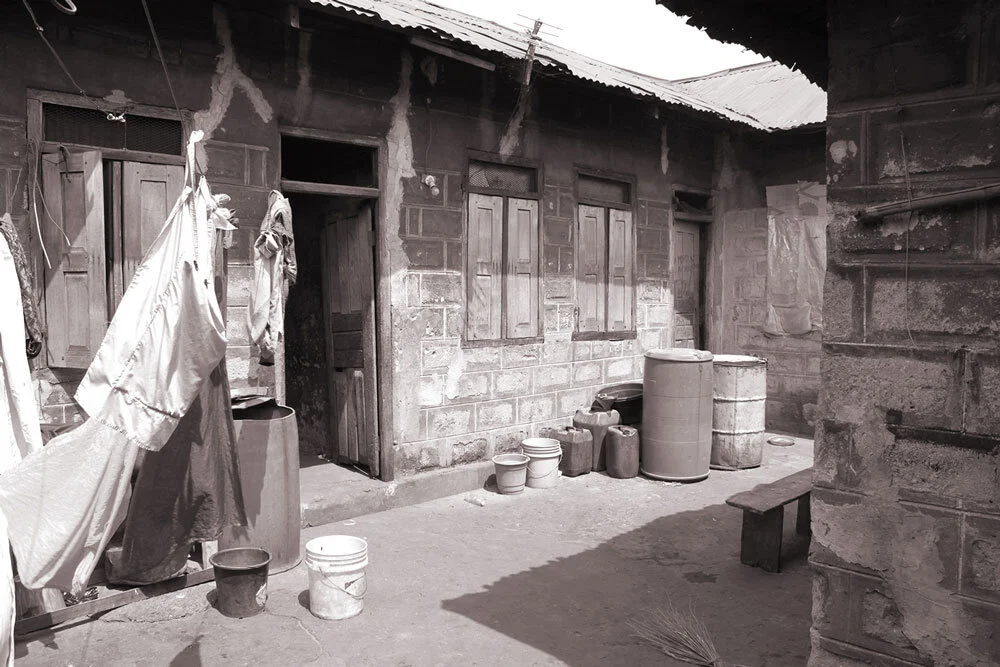
Tenement building - Originally built for a single extended family, now several families can occupy one or more rooms. Rooms facing the street can also be rented out as shops

 
Tenement building - Courtyard

Tenement building - Courtyard

Tenement building - Kitchen

Tenement building - Kitchen

/ Research - Site

The 1.9 hectare site is comprised of virgin land to the north east of the city, near Okwuta village in an area which is rapidly becoming more central due to urban sprawl.

Currently populated with palm trees and undergrowth, the site slopes from the north east to the south west, a height difference of approximately 10m with a south westerly prevailing wind. The roads around the site are in poor condition but will likely be upgraded in future due to the areas development


Existing site plan - Development has been rapid, but slower than possible due to the difficulty in titling ancestral lands

 
 Site - Southern access rd, view to East   

Site - Southern access rd, view to East   

 Site - Interior

Site - Interior

 Site - High income developments are increasing on previously undeveloped land

Site - High income developments are increasing on previously undeveloped land

Typical house types - The creation of a new government complex near the site has made the land more valuable, and many large houses are springing up on the previously undeveloped land.

Typical house types - The creation of a new government complex near the site has made the land more valuable, and many large houses are springing up on the previously undeveloped land.

 
Typical settlment pattern - Site as would be typically laid out in a modern housing estate

Typical settlment pattern - Site as would be typically laid out in a modern housing estate


/ Proposal - Site Strategy

Principles learnt from the research into Igbo traditional architecture and relevant low cost housing schemes were brought together into the specifics of the site and the context of Umuahia to create a development in contrast to the typical grid iron pattern

Relevant Aspects of Igbo Architecture

The overall concept is based around 5 clusters of residential units, 4 low income and 1 high income, which are assembled around a central civic communal space. Several units are centred and accessed through a compound courtyard, these compounds are in turn centred around a communal cluster courtyard and the clusters in turn lead to the central civic space.

 Concept - 5 clusters of residential units, 4 low income and 1 high income, assembled around a central civic communal space, with a hierarchy of open spaces, from the private to the public

Concept - 5 clusters of residential units, 4 low income and 1 high income, assembled around a central civic communal space, with a hierarchy of open spaces, from the private to the public

 Low Rise High Density - Low rise buildings of maximum 3 storeys are used to try and increase density , whilst allowing for ample communal space

Low Rise High Density - Low rise buildings of maximum 3 storeys are used to try and increase density , whilst allowing for ample communal space

 Security & Access – The peripheral road allows the interior of the site to be car free, and more space for communal use. Due to security issues, a perimeter wall with security post and one point of entry and exit is necessary

Security & Access – The peripheral road allows the interior of the site to be car free, and more space for communal use. Due to security issues, a perimeter wall with security post and one point of entry and exit is necessary

 Public & commercial - Commercial activity  surrounds and activates the central civic space. At the south of the site a workshop is located which acts as a hub for the building activity during the construction phases as well as incremental additi

Public & commercial - Commercial activity surrounds and activates the central civic space. At the south of the site a workshop is located which acts as a hub for the building activity during the construction phases as well as incremental additions at later stages

 Mixed Income - Higher income units are located to the north east at the highest and most desirable point of the site. They will help subsidise infrastructure for the rest of the development and promote the idea of alternative building methods from a

Mixed Income - Higher income units are located to the north east at the highest and most desirable point of the site. They will help subsidise infrastructure for the rest of the development and promote the idea of alternative building methods from a top-down approach.


Site Model - Residential clusters surround a central communal space


Site Section - the site slopes from the north east to the south west, a height difference of approximately 10m, with the high income cluster located at the highest point of the site

Site Overview - The density is in contrast to surrounding plots, which are  currently  undeveloped due to land titling issues,  but will ultimately densify due to urbanisation forces


Site Plan


/ Proposal - Clusters and Compounds

Smaller compound courtyards lead into cluster courtyard and ultimately into the central civic space. 2-3 storey volumes create a low rise high density environment.

Cluster Axonometric – Smaller compound courtyards lead into cluster courtyard and ultimately into the central civic space. 2-3 storey volumes create a low rise high density environment.


Cluster Elevation


Cluster Plan


The cluster courtyard space is activated by the surrounding semi-public compound courtyards. The concrete structure and bands of door and window openings gives rhythm to the facade. Brick screens provide ventilation privacy and variety. Vertical bamboo planters can be applied to blank walls.

Cluster Courtyard


The plan is based around a simple 4x4m concrete frame structural grid, with non structural infill which allows for later additions, whilst maintaining an architectural language. The plans are one room deep allowing for cross ventilation. Each unit is provided with private outdoor space (terrace or rear garden) and use of the semi public compound courtyard. The grid structure allows for flexibility both horizontally and vertically.

 Compound Plan - Ground

Compound Plan - Ground

 Compound Plan - First

Compound Plan - First

 Compound Plan - Second

Compound Plan - Second


Verandahs and the slender floor plan emphasise the outdoor space. The materiality of bamboo and earth matches the exterior. Jalousie windows help with cross ventilation.

Ground Floor Unit


The steeply pitched roofs provide protection from sun and rain. The low walls around the courtyard provide privacy and seating. A perimeter verandah helps to encourage outdoor living.

Where possible the use of local materials will be used to reduce the consumption of concrete as well as to link back to the vernacular. Bamboo for the roof structure, earth in the form of compressed earth stabilised blocks for walls and paving, rammed earth for foundations and floors and coconut fibre cement composite roof tiles

The building typology is based on a bamboo framed roof, which sits on top of a concrete frame. Layering in the roof allows hot air to rise and radiated heat to dissipate before entering the interior. Composite tiles perform better thermally than metal sheeting and can be produced on site in the workshop.

Compound Section

View fullsize Detail.jpg
View fullsize House-section_f.png
View fullsize Detail2.jpg

/ Proposal - Incrementality

The basic grid system allows for various typologies, which residents can design when choosing their starter home. Residents can add 50% or more of floor area to their initial plot.
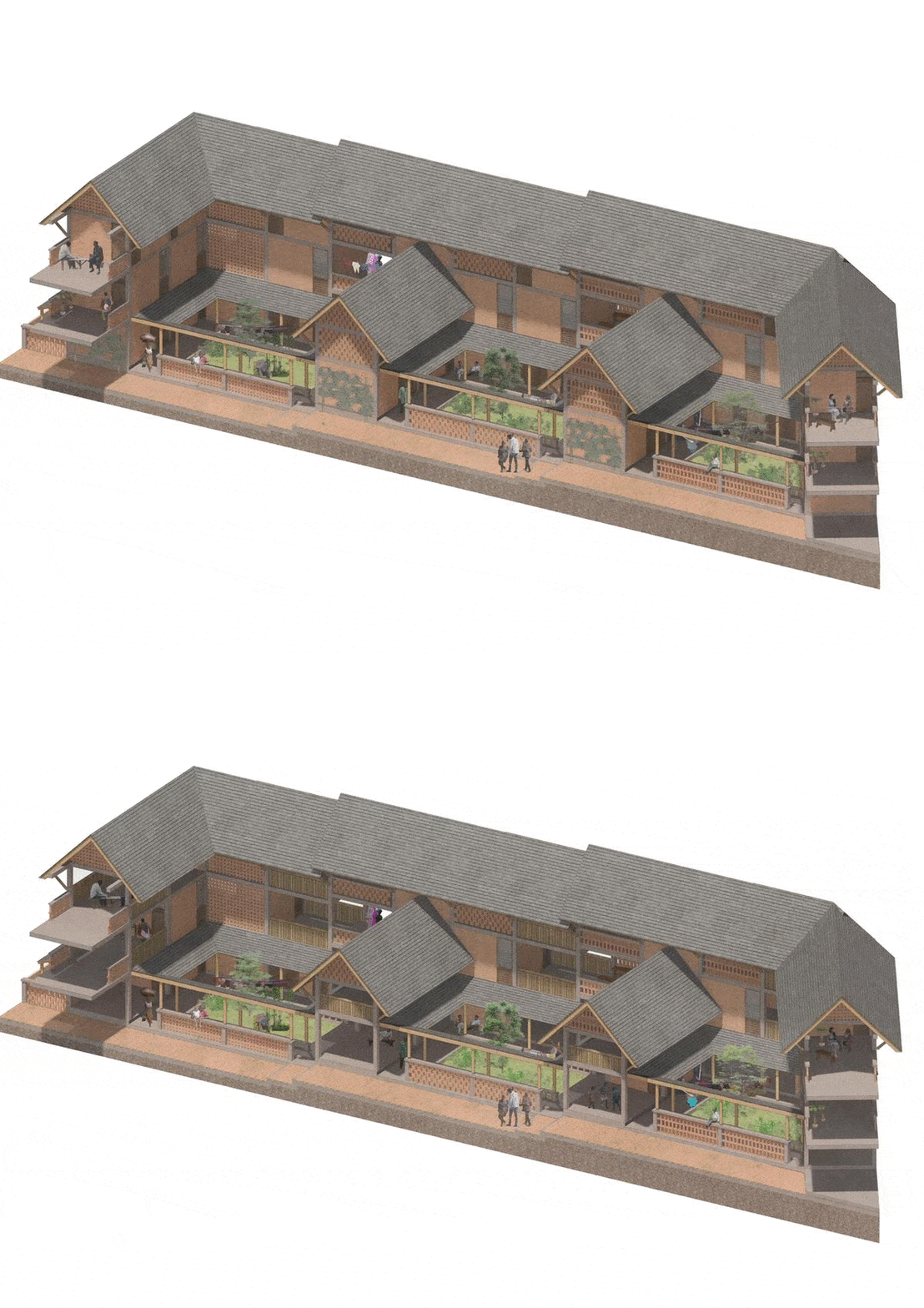
Incrementality - Axonometric diagram showing starting vs infilled states. Temporary bamboo balustrades are used for empty bays

Incrementality - Axonometric diagram showing starting vs infilled states. Temporary bamboo balustrades are used for empty bays

An example is a unit based initially on 2 bays - a kitchen, bathroom and living space - which then expands to 5 bays

 3 Bedroom flat - Horizontal expansion | 2 - 5 bays | 28m2 - 70m2

3 Bedroom flat - Horizontal expansion | 2 - 5 bays | 28m2 - 70m2

 2 Bedroom Maisonette - Vertical expansion | 2 - 4 bays | 28m2 - 56m2

2 Bedroom Maisonette - Vertical expansion | 2 - 4 bays | 28m2 - 56m2

 4 Bedroom House | Vertical expansion | 3-6 bays | 28m2 - 84m2

4 Bedroom House | Vertical expansion | 3-6 bays | 28m2 - 84m2


Groups of residents are pre-selected per compound, for example via a civil service run scheme. A plot is assigned and they are instrumental in designing their starter home layout. Early involvement is sought at this stage to try and form community ties

Compound development

/ Proposal - Central Civic Space

The central civic space is at the heart of the site and is activated by commercial and public functions which wrap around it. A covered walkway leading to the main meting hall lines the perimeter offering seating for events and chance encounters

Central Civic Space - The central space is designed to be multi-purpose in order to cater for larger events

Central Civic Space - Elevation

The communal area uses the same language as the rest of the development but is more expressive with round compressed earth composite columns reminiscent of traditional carved posts, decorative earth pavers and decorative screens and doors with geometric patterns on the main meeting hall

Central Civic Space - View from walkway around the periphery of the site

The meeting hall is conceived as a bamboo roofed structure, housing a first floor gallery, which is supported by a heavy more enclosed rammed earth base. It is surrounded by a continuous verandah, with wide overhangs and a continuous flow between the indoors and outdoors

 Meeting Hall - Exterior

Meeting Hall - Exterior

 Meeting Hall - The upper floor gives a view of the surroundings whilst taking advantage of the south-westerly prevailing wind

Meeting Hall - The upper floor gives a view of the surroundings whilst taking advantage of the south-westerly prevailing wind

 Meeting Hall - Reference

Meeting Hall - Reference

 
Meeting Hall - Section

Meeting Hall - Section

Due to security issues a boundary wall is planned. By increasing the depth and providing a roof in some segments, pockets of activity can line the boundary of the site and create an alternative use for the wall from trading stalls to seating, food production and planting.

Boundary Wall

Boundary Wall

Examples of decorative elements

 Decoration - Brick screens

Decoration - Brick screens

 Decoration - Brick paved walkways

Decoration - Brick paved walkways

 Decoration - Decorative blocks

Decoration - Decorative blocks